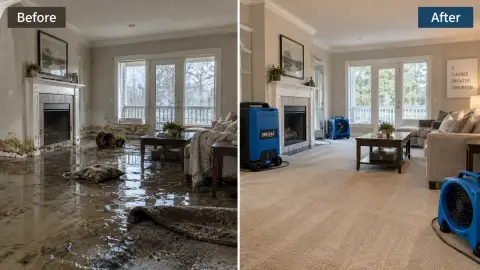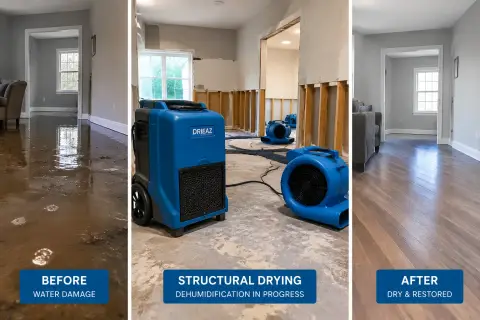
Fort Lauderdale, in Broward County, is a low-lying area built along the water with roughly 185,000 residents. Known as the "Venice of America" for its more than 165 miles of canals, Fort Lauderdale is built around water. Water damage here follows the pattern of the area: canal-front, river-front, and bayfront homes, many close to sea level. When water gets into one of those buildings, the clock starts immediately, because Florida's warm, humid air lets mold begin growing in as little as 24 to 48 hours.
Fort Lauderdale sits roughly 36 feet above sea level. If you are dealing with a leak, a flooded room, or storm damage in Fort Lauderdale, call (305) 789-7628 any time, day or night. We serve 27 ZIP codes in Fort Lauderdale and nearby communities such as Dania Beach, Plantation, Pompano Beach, and Hollywood, and we document every job with photos and moisture readings so your insurance claim has what it needs.
Why water damage happens in Fort Lauderdale
Fort Lauderdale has canal-front homes with seawalls and low first floors, older 1950s and 1960s concrete-block homes, and dense condo towers along the beach and Intracoastal. The April 2023 flood, when more than 25 inches of rain fell in about a day, flooded many of these properties. Broward is low, flat, and canal-cut, and much of it sits only a few feet above sea level. In extreme rain events the storm drains and canals fill faster than water can leave, and in king-tide season saltwater can push up through street drains.
Every part of Florida has its own way of letting water in. In Fort Lauderdale, these are the problems we see and plan for most often:
- Extreme rain events like the April 2023 flood, when canals and storm drains could not keep up
- Flooding from heavy rain when canals, rivers, and drainage systems fill faster than they can drain
- High tides and king tides that push water into low streets and yards
- Storm surge that overtops seawalls and enters lower floors and garages
- Rising groundwater and sewer or septic backups when the ground is saturated
Storm and flood history in Broward County
Recent history shows why homeowners in Fort Lauderdale should not wait to act when water gets inside.
- Hurricane Wilma (2005) crossed South Florida with hurricane-force gusts.
- Hurricane Katrina (2005) first came ashore as a Category 1 hurricane on the Broward–Miami-Dade line.
- the April 2023 Fort Lauderdale flood (2023) dropped more than 25 inches of rain in about 24 hours and flooded thousands of homes and cars.
- the June 2024 South Florida flood (2024) brought multiple feet of standing water to Hollywood and Fort Lauderdale neighborhoods.
Common water damage situations in Fort Lauderdale
A canal-front home fills after an extreme rain event. When more than two feet of rain falls in a day, as in April 2023, canals, storm drains, and seawalls cannot keep pace, and water rises through garages and doorways of homes that have never flooded before.
A condo unit above the beach or Intracoastal has a water heater failure. Water moves through the slab and down risers to units below. Multiple insurers and an association are usually involved, so clear documentation matters as much as fast drying.
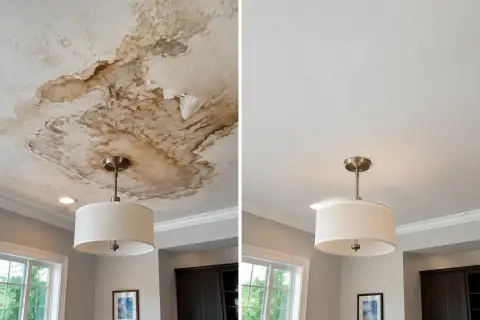
Salt air corrodes plumbing and AC coils. Near the beach and the Intracoastal, corrosion produces slow leaks that stain ceilings and grow mold in wall cavities long before there is a visible puddle.
Where we work in Fort Lauderdale
We work throughout Fort Lauderdale, including areas near Las Olas Boulevard, Fort Lauderdale Beach, Port Everglades, the Broward Center for the Performing Arts, and Riverwalk.
Neighborhoods and areas we regularly serve include Las Olas Isles, Victoria Park, Rio Vista, Coral Ridge, Wilton Manors area, Flagler Village, Lauderdale-by-the-Sea area, Sailboat Bend, Progresso, and Imperial Point.
Crews responding in Fort Lauderdale also cover the surrounding area, including Dania Beach (about 6 miles south), Plantation (about 7 miles west), Pompano Beach (about 7 miles north), Hollywood (about 8 miles south), and Hallandale Beach (about 10 miles south).
Fort Lauderdale is close to the New River and the Intracoastal Waterway, and that water shapes local risk: tides, rain, and river or canal levels decide how quickly streets and yards flood.
ZIP codes we serve in Fort Lauderdale
- 33301
- 33304
- 33305
- 33306
- 33308
- 33309
- 33311
- 33312
- 33313
- 33314
- 33315
- 33316
- 33317
- 33319
- 33321
- 33322
- 33323
- 33324
- 33325
- 33326
- 33327
- 33328
- 33330
- 33331
- 33332
- 33334
- 33351