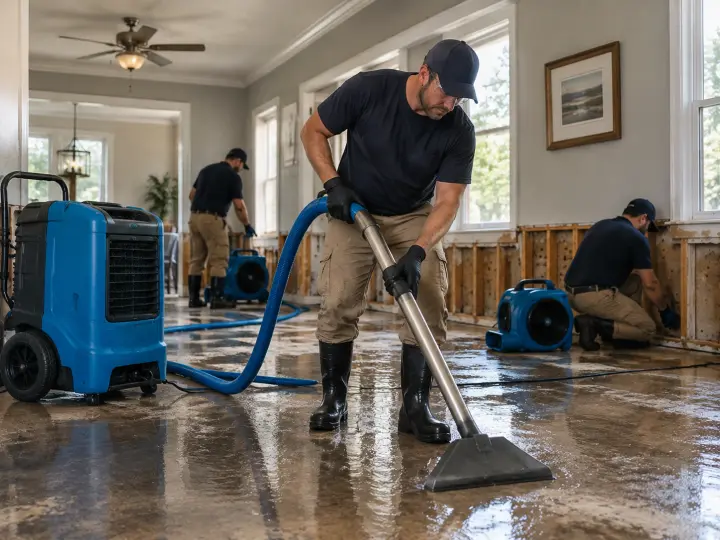
Panama City, in Bay County, is a low-lying area built along the water with roughly 33,000 residents. Panama City is the Bay County seat on St. Andrew Bay and was directly hit by Hurricane Michael in 2018, one of the strongest hurricanes ever to strike the U.S. mainland. Water damage here follows the pattern of the area: canal-front, river-front, and bayfront homes, many close to sea level. When water gets into one of those buildings, the clock starts immediately, because Florida's warm, humid air lets mold begin growing in as little as 24 to 48 hours.
Panama City sits roughly 26 feet above sea level. If you are dealing with a leak, a flooded room, or storm damage in Panama City, call (305) 789-7628 any time, day or night. We serve 6 ZIP codes in Panama City and nearby communities such as Lynn Haven, Panama City Beach, Inlet Beach, and Santa Rosa Beach, and we document every job with photos and moisture readings so your insurance claim has what it needs.
Why water damage happens in Panama City
Panama City is still rebuilding after Michael. Many roofs were replaced or patched, and many homes and businesses were rebuilt to newer wind codes, but temporary repairs and older roof systems are still a common way for water to reach ceilings and attics. After Hurricane Michael, a large share of Bay County roofs were repaired or replaced, and many homes were rebuilt to newer wind codes. Older roofs, temporary repairs, and blue-tarp patches are still a common way for water to get into ceilings and attics.
Here is what typically causes water damage in Panama City, based on the local housing and setting:
- Roof and window failures left over from Hurricane Michael, which let wind-driven rain into buildings
- Rising groundwater and sewer or septic backups when the ground is saturated
- Flooding from heavy rain when canals, rivers, and drainage systems fill faster than they can drain
- High tides and king tides that push water into low streets and yards
- Storm surge that overtops seawalls and enters lower floors and garages
Storm and flood history in Bay County
Recent history shows why homeowners in Panama City should not wait to act when water gets inside.
- Hurricane Eloise (1975) caused heavy damage along Panama City Beach.
- Hurricane Michael (2018) made landfall as a Category 5 just east of Panama City, destroying homes and stripping roofs from thousands more.
Common water damage situations in Panama City
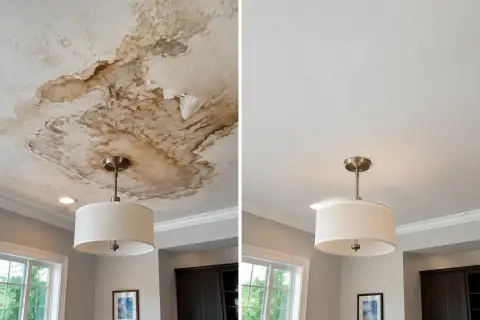
A roof that was repaired after Michael leaks. Temporary repairs and patched roofs from the years after Hurricane Michael are still a common source of water into ceilings and attics.
Wind-driven rain enters a bay-front home. St. Andrew Bay homes take rain and surge, and older windows and doors can leak.
A rebuilt commercial building has an HVAC or roof issue. Businesses that were rebuilt after Michael have new systems, but early failures still happen.
Where we work in Panama City
We work throughout Panama City, including areas near St. Andrew Bay, the Panama City Marina, Gulf Coast State College, Tyndall Air Force Base, and Oakland Terrace.
Neighborhoods and areas we regularly serve include Downtown Panama City, Cove, St. Andrews, Millville, Cedar Grove, Lynn Haven area, and Oakland Terrace.
Crews responding in Panama City also cover the surrounding area, including Lynn Haven (about 5 miles north), Panama City Beach (about 8 miles west), Inlet Beach (about 22 miles west), Santa Rosa Beach (about 32 miles northwest), and Freeport (about 36 miles northwest).
Panama City is close to St. Andrew Bay, Lake Powell, and Deer Point Lake, and that water shapes local risk: tides, rain, and river or canal levels decide how quickly streets and yards flood.
ZIP codes we serve in Panama City
- 32401
- 32403
- 32404
- 32405
- 32408
- 32409